Stephan Mairesse
Dog Trainer & Behaviorist

Articles

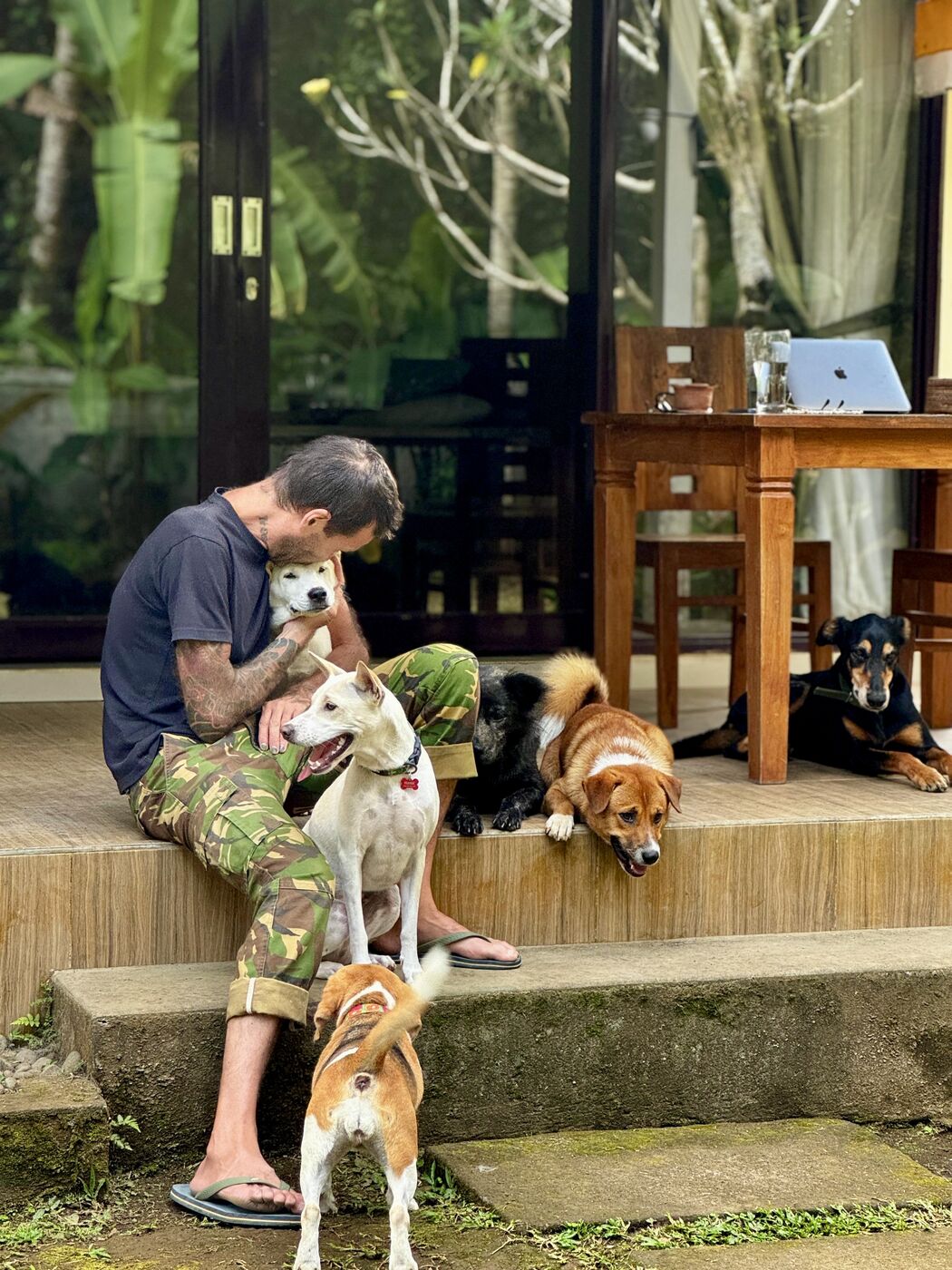
Stephan Mairesse with a dog

"NO CONSEQUENCE, NO OBEDIENCE." WHAT ABOUT POSITIVE REINFORCEMENT?

I've used positive reinforcement for 30 years, and I don't dismiss it. I use it each time I ask a dog to obey.

Training a dog with positive reinforcement only is a beautiful idea — and I'd rely on it exclusively if it were beneficial to a dog's wellbeing and genuinely effective for obedience.

But out in the field, that beautiful idea falls apart.

Without some form of discomfort when your dog disobeys, you have no grounds to expect obedience in the first place. If your dog would rather do something else, and disobeying costs him nothing, why would he ever choose to listen to you?

I don't dismiss "positive reinforcement only" training out of choice, but out of necessity.

THE ESTABLISHMENT OF A HIERARCHY BETWEEN INDIVIDUALS OF DIFFERENT PACKS

I've had the opportunity to observe dog packs in many countries: India, Portugal, several North African countries, the Dominican Republic, Turkey, and Mauritania. This fascinates me — and those observations also served a specific purpose: to confirm, or refute, the findings of my theoretical studies in ethology and canine behavior.

Nowhere else have I had as many dog packs available to study as I have in Bali over the past four years. I can observe a multitude of them constantly, since these packs are present all over the island — on the beach, in the streets, around the rice paddies, in the mountains — literally everywhere, and in great numbers.

This is a goldmine for me, especially since these dogs live alongside humans without being cared for by them, in the sense that humans don't interfere at all in the dogs' interactions. Humans can approach them very closely, but cannot touch them, with rare exceptions.

These four years of study have led me to discover something I had never read about in any research: a hierarchy exists between individuals from different packs when they come into regular contact — for instance, when one pack crosses another's territory. Members of a pack newly arrived in an area of already-occupied territory will fight, or engage in highly conflict-ridden interactions, with members of neighboring packs, until a hierarchy is established among the individual members of the different packs. Once that stage is reached, fights and conflicts become sporadic, and the established status remains stable — at least as far as I've been able to observe.

1000 TIMES A DAY IN THE UNITED STATES, A DOG SENDS ITS "OWNER" TO THE EMERGENCY ROOM

Still don't believe in hierarchy? Yet every day in the United States, 1000 people are treated in hospital emergency departments for a dog bite, according to the National Electronic Injury Surveillance System (NEISS-AIP). And more than 80% of these bites happen... at home — inflicted on family members and close friends.

Treat your dog like a human, and sooner or later it will remind you of its true nature.

Why do these accidents happen? For Monique Bourdin, veterinary doctor at INSERM, graduate of the Institut Pasteur, and responsible for teaching behavioral disorders at the French national veterinary school, the answer is clear: "Accidents by bites are essentially linked to the failure to respect the species' way of life." She adds: "The dog is a social being; to thrive, it must live this hierarchical relationship in food, territory, and contacts. This is the only way to structure and soothe the animal."

Perhaps, at some point, you will stop believing the social media fairy tales claiming that dogs are not hierarchical animals, and that it is fine to let them onto your couch or bed. The "professionals" who tell you this bear some responsibility for these bites.

"WHEN THE DOG NO LONGER FOLLOWS ITS ‘OWNER’"...

Experience shows me how difficult it is for owners to change the way they perceive their animals and to impose rules of life on them. I am confronted with human resistance to getting rid of anthropomorphism, with their difficulty in perceiving their dog as a species different from ours, whose behavior and needs are specific to it.

I understand those difficulties all the better because I was confronted with them myself, with my first dog, Ares. Before studying dogs, I had considered Ares a friend — an animal I could treat as an equal, with whom I could share everything. I didn't know he was a rival. To me, he was "the human's best friend," as the dog is so wrongly called.

As long as I treated him as I wanted him to be, and not for who he really was, I couldn't resolve the difficulties I encountered with him (Ares had become a rather aggressive dog). It was only when I learned his true nature and established rules of life that respected his needs that I was able to bring Ares under control.

Change cost me. I had to mourn the image I'd had of the dog — mourn a way of relating that pleased me, but which was harmful to my dog.

I learned that Ares had taken power from me. His aggressiveness was used to defend his territory (not mine), to maintain his status, and to preserve social cohesion with my family and close friends. I understood that to stop his aggressive behavior, I had to strip him of that power and take over leadership of the pack I was forming with him. This would relieve him of the heavy responsibility of ensuring our group's survival. I had to completely rethink the way I behaved with him. It wasn't at all obvious to me — I had the feeling I was going to be "bad," or not "nice," to him.

I see this same feeling in the majority of dog owners who come to me, and having lived through it myself, I understand very well their apprehension about change. Changing your relationship with your dog stirs up a lot inside you. It touches the emotional domain — the image we reflect to others. I've lost count of the people to whom I've explained the behavior to adopt with their dog, who respond, "But my dog won't love me anymore!" I explain to them that the more they lead their dog, the more attached he will be to them. Dogs are genetically programmed to follow a consistent leader — a leader who gives them the best chance of survival.

I explain to them what I learned while boarding dogs. When owners entrusted me with their dog for boarding, if they hadn't taken on that leadership role, or had been inconsistent with their animal, many of them found, when they came to pick their dog up, that he wouldn't follow them. The dogs could completely ignore their owners, without even looking at them. Numerous owners thought their dog was much better off at home than with me, because at home he was entitled to the sofa, to food at the table… Yet, to their own surprise, their dog preferred to stay with me. I saw owners grow angry with their dog because he'd snubbed them. Many had to leash their dogs just to get them to leave my house. It calls into question the dog's legendary loyalty…

LETTER TO DOGS

My favorite animal on earth, what did we do to you?

You decided to get closer to us tens of thousands of years ago. You were the first animal we domesticated. You have provided immeasurable help — for hunting, for security, and later for saving human lives buried in rubble; you've saved humans from drowning; you help us herd, detect bombs, detect cancer… and so many other jobs. Your mere presence at our side brings us so much joy… You are the species closest to us, and our evolution, according to some ethologists, would certainly have been different without you.

But what have we done with you?

Today we humanize you — we put you in strollers, in baby carriers, in our beds, at the table with us… we have forgotten, or don't want to see, who you really are. We mistreat you. We mistreat you because we don't provide for your essential needs, because we refuse to see your true nature. Far from offering you a soothing presence and security, we have passed on to you stress and anxiety, which you express by screaming when left alone, by destroying things, by relieving yourself at home, by self-mutilating — and in many subtler ways your owners never even notice… We mistreat you, and yet we loudly proclaim how much we love you. We proclaim to love you, but we don't love you for what you are. We love what you are not, and what you will never be: a child, a human.

My fellow men dress you, take you to spas, celebrate your birthday — not understanding that your well-being and fulfillment lie far elsewhere.

When I began studying you, trying to understand you, more than 25 years ago, your owners were embarrassed — rightly so — to admit that they let you sleep in their bed. Today, on social media, they take pride in it, and are praised for it. And when you bite — when your nature calls us to order — you are blamed, abandoned, and, all too often, put down. You were guilty of showing a side of your reality that you're asked to hide, on pain of… death. I am deeply saddened by this, sorry for it, desperate about it — and it often makes me sick.

When will humans understand that imposing rules of life on you soothes you, makes you feel safe, and is not mistreatment — that it is, in fact, a profound form of care? When will they understand that walking you for two hours in nature, rather than wheeling you around the shops in a stroller, is what you actually need? They prefer to comfort themselves with illusions in which they find their own happiness and satisfaction, no matter what it costs you. And yet, listen to them whisper that they love you… listen to their friends telling them what great "pawrents" they are. And I — I am so sorry for you.

I am lucky to live by your side, and lucky to work with you and for you. For years, I have been explaining to owners who you really are, using every means at my disposal — quoting real specialists, like Patrick Pageat, who explains: "The notion of hierarchy contributes to a dog's well-being and balance. It is up to the owner to take responsibility for that role, and only then will the animal be happy. An animal that doesn't have to lead the pack will feel secure, since its needs will be taken care of. To be dominated does not mean to be humiliated — it means to be protected by the group, to feel safe." (Patrick Pageat is a veterinary doctor and a doctor of natural sciences, specializing in veterinary behavioral medicine in France. He is the founder and Scientific Director of IRSEA, the Institute for Research in Semiochemistry and Applied Ethology, and created the clinical teaching program "Behavioral Medicine and Consultation" at France's national veterinary school.)

Those echoes of truth seem to fade further away as louder and louder voices claim to care for the very animal they love.

Yes, they love you — but in such a harmful, horrible way.

CESAR MILLAN AND ENERGY

Part 1

In dog training, I use neither energy (Cesar Millan) nor treats. The reason why I don't use treats can be found on this account or on my website.

Cesar Millan defines energy as: Intention × Emotion. He further explains that "the ideal leadership energy is steady, quiet, confident, and compassionate."

So, mastering your emotions and achieving steadiness, quietness, and confidence — which is not an emotion but rather a cognitive state or behavior — are, according to him, essential.

So, if you are not a highly trained yogi, couldn't you still be a leader for your dog?

In life, even day to day, who can remain steady and quiet for even a couple of hours? In those moments of unsteadiness and restlessness, when your mind is turbulent, do you lose leadership — or is your leadership merely threatened?

My view is that what makes you a good leader is consistency, which also means predictability. And here is the core of my disagreement with Cesar Millan's opinion: I believe this consistency, regardless of your emotional state, is what makes you a good leader. Meaning that no matter if you are sad, depressed, excited, joyful, feeling confident or deeply unconfident, the rules you must apply to be a good leader won't change.

Predictability is also the ground on which reliance becomes possible. If we don't know how people, or things, will react, trust isn't possible. Trust is a feeling of security and assurance, and we cannot feel secure if things or people are unpredictable.

If the qualities described as "energy" were truly necessary to be a good leader, one would have to be Buddha to succeed.

Part 2

So, according to Cesar Millan, being "steady, quiet, confident…" — key parts of what he calls "energy" — is what one must have to be a good leader.

How does a dog gain access to leadership?

First, because he spots a flaw or a weakness in the leader and exploits it. Since the leader is no longer fit to lead — due to this new weakness — he must be replaced; that's nature's programming. The dog who becomes the new leader hasn't evolved to reach that status; he hasn't gained anything, he has simply seized an opportunity.

Second, the dog who becomes the leader has reached maturity — he becomes an adult, enters the adult hierarchy, and tries to get the social position he believes he can attain. And if he is stronger, in several ways, than the current leader, he will take that position, either right away or over time.

If we observe that this dog has certain qualities matching what Cesar Millan defines as "energy," that's what interests us here — because we can then say the dog has gained those qualities. In fact, they were mostly dormant and emerged as he grew up; I can say this with some confidence, because we can already sense these qualities in certain puppies. But are those developed qualities what made him or her the new leader — or are they only a means to it, not a requirement?

In other words, are these qualities intrinsic to a leader? If not, Cesar Millan's "energy" philosophy — which defines what a leader is — simply falls apart.

If "steady, quiet, confident…" are essential to being a leader, then unless we already have them, we couldn't be good leaders. Having the right "energy" implies we have to reach it, and the only way is to work on it.

Changing our character traits, our personality, is one of the hardest things in life — exactly why people spend decades in therapy, yoga, meditation, and so many other practices, with mixed success and painfully slow change. That would mean becoming a good leader takes years, with no guarantee of success.

I fundamentally disagree with this view. I believe those qualities are just a means to access what makes you a leader. They are only a means — one that can be bypassed or replaced — and therefore not essential, not intrinsic.

A means to what, exactly? To having control over everything that is vital: food, territory, reproduction, but also movement and physical contact. And it is having control over those five that makes you the leader.

You can perfectly control those five without being "steady, quiet, confident…" at all. In fact, if you are still applying those rules while being unsteady, restless, and unconfident, then — and only then — are you a great leader. If you don't control those five, but have the "energy" as defined by Cesar Millan, you won't be a leader. In fact, while having that "energy," you can still be at the bottom of the hierarchy…

You are a good leader because, no matter the changes — internal (emotions) or external (the outside world) — you control those five. You stay the course, no matter what.

I also claim that we can become a leader within 24 hours. If so, that proves we don't need to acquire that "energy," which is the very ground of Cesar Millan's training philosophy.

Proof?

Here are messages sent by owners, within 24 hours of applying those five — you can check the feedback for yourself on Instagram:

"I practically have a new dog!!!"

"The amount of calm that has taken over my house and my pack is literally incredible, and that calm is also very much in me 🙏"

"I am so so happy with our work and already looking forward to proceed Saturday. 🙂 The improvement is already so big in terms of behaviour that I can hardly believe it."

"She's become so much calmer, and honestly just a happier little soul."

"This fella is behaving SO GOOD since."

I didn't write this to spit on Cesar Millan, or to try to make a name for myself by objecting to his views. Cesar Millan is far more skillful at handling dogs than most professionals who criticize him. I wrote this to explain why I disagree with his notion of "energy," in the hope of giving other lights to owners in search of help.

BALI, THE ISLAND OF AUTHENTIC DOGS.

I've been able to observe dogs in different states: familiar, domestic, and wild. I've seen them in Western countries, where they are almost entirely companion dogs, and I've seen them in countries where many are stray dogs: North Africa, Portugal, Mauritania, the Dominican Republic, India, and finally, Bali.

The dogs in Bali were an exception in my observations.

When I arrived here, I didn't understand why I couldn't touch the dogs I passed while walking, even though they lived with families. These dogs are free to come and go in and around houses — they live in the territory they've made their own.

These dogs would approach me, bark at me, but as soon as I reached out to pet them, they'd run away and show signs of fear. I didn't understand why, and this question kept nagging at me: why did almost all of them react this way when they lived with families? In some other countries, dogs are rightly afraid of humans, because they're chased away, sometimes violently, whenever they approach a person. But here, I've never seen any aggressive gesture toward a dog. So why were they afraid of humans?

First hypothesis: a behavior reproduced through imitation, from generation to generation — the mother behaves this way, and her puppies, who learn partly by imitation, observe her and then imitate this behavior, which they will in turn pass on to future generations. For this to happen, some initial trauma must have occurred, since this behavior is undoubtedly rooted in fear. On such a large scale and across such diverse locations, that seemed unlikely — but it remained a hypothesis.

Second hypothesis: genetic transmission.

The answer came to me when I took part in a sterilization campaign in a village. To sterilize the dogs, "the owners" had to bring them to us, and I noticed that none of them were able to touch their own dog — it was very difficult to even catch them. I then understood that almost all these dogs live with families, but no physical contact is ever exchanged, not even from birth. The puppies therefore receive no imprinting from physical contact with humans, and develop reactions of fear whenever that contact is attempted, simply because they're not used to it.

This very particular status is fascinating, because it harks back to the very beginning of the domestication of the wolf, which gave rise to the dog. The wolf approached humans to eat their leftovers, and humans saw in the wolf's presence a formidable tool for guarding and hunting: a cohabitation was born from the fruits of that collaboration. It was then that we domesticated the wolf and, by beginning to master its reproduction, transformed its physical appearance and named it "dog."

In Bali, the dog is in exactly the same situation: it stays close to humans, where it finds food, and guards a territory it considers shared — family plus dog. Whether the Balinese accept the presence of dogs for this reason, or simply because they're used to living among them, doesn't change the reality of this cohabitation — it doesn't change the fact that these dogs are, in every respect, the "prototypes" of the animal we originally domesticated. Utterly fascinating to observe.

Equally fascinating: the adaptability of this species. These dogs, who behave this way generation after generation, are capable of adapting to humans within a single generation. I myself have adopted, and have worked with clients who've adopted, puppies found at just a few weeks of age. As these puppies grow, they come to behave exactly like companion dogs in Western countries — taking on the same characteristics as dogs specifically bred for companionship. They become quite sociable. This makes the dog a remarkably adaptable species.

Having the chance to observe and work with these dogs is an invaluable source of knowledge for my profession. Observing them is like a journey through time that I'm given the opportunity to take — one that leads all the way back to when the wolf was first domesticated.

IS A DOG'S TEMPERAMENT DETERMINED BY ITS BREED?

Is a Labrador necessarily a friendly family dog with no aggression in him? Is a Pitbull necessarily a particularly aggressive dog?

Patrick Pageat wrote: "If nothing special is done with him, the Pitbull is a dog like any other (...) He is no different from any other dog (...) neither more nor less peaceful." (Patrick Pageat is a veterinary doctor and a doctor of natural sciences specializing in veterinary behavioral medicine for French pets. He is the founder and Scientific Director of IRSEA, the Institute for Research in Semiochemistry and Applied Ethology, and created the clinical teaching program "Behavioral Medicine and Consultation" at the Alfort veterinary school.)

A breed is defined by morphology (large, small, hairy...) and by natural aptitudes — the tendency to instinctively perform the tasks the breed was selected for, such as hunting or guarding. But a breed absolutely does not determine temperament, which is unique to each individual.

Studies in this area estimate that heredity accounts for at most 20% of behavior, and even within that 20%, we don't know how much is attributable to genuine hereditary transmission and how much to puppies simply imitating their mother in the first weeks of life. What's more, behavior (fleeing a potential danger, reacting aggressively in a given situation...) should not be confused with temperament traits (being stubborn, sensitive...). Within a single litter, puppies — despite coming from the same parents and growing up in the same conditions — will develop extremely different temperaments.

Over my 20 years of professional practice, I have seen temperaments vary enormously within every breed. When clients who have owned several dogs of the same breed tell me about it, and I ask whether their dogs had the same character, the answer is invariably "no!"

It is therefore important not to rely on articles or books that describe a supposed temperament specific to a breed.

RULES OF LIFE AND OBEDIENCE ARE BASIC AND FUNDAMENTAL NEEDS

In the wild, dogs engage in a great deal of mental activity — linked, among other things, to foraging for food, to the strategies used for hunting, and to seeking out and defending territory.

Without that mental stimulation, a dog can develop behavioral disturbances, such as licking a wound raw, or spinning in circles chasing its tail for hours.

These behaviors are seen in wild animals caged in zoos, but never in wild animals trained for film work, for example — even though their living conditions are similar. The difference lies in activity: film animals are worked through exercises and are therefore mentally stimulated.

This is why training is essential for the companion dog, who no longer has a "job" to do.

THE DOG AND THE HUMAN ATTACHMENT

When he leaves the breeder, the puppy transfers the vital attachment he had to his mother onto a member of his new family.

This is usually whoever spends the most time with him right after he leaves the breeder. This bond will evolve, and after detachment and puberty will be shaped by sexuality and by the hierarchical order that becomes established. In adulthood, the dog will be attached to the people who dominate him. They are his guides, the ones he can rely on, because they are the ones who look after his needs.

The dog is programmed to follow whoever is best able to ensure his survival, so some dogs may want to follow and go off with people other than their owner. This depends on the dog's individual sensitivity, but above all on his hierarchical position.

Above all, the dog is "faithful" to whoever dominates him.

DOG TRAINING AND PRECONCEIVED IDEAS

- A dog has only one owner.

It's true that a puppy carries over his attachment bond to one particular person, but he can have several "masters" — anyone who holds a hierarchical rank above his own.

- You have to speak harshly to a dog to be obeyed.

A dog can obey hand signals alone, which shows that obedience doesn't depend on a firm voice. A soft, pleasant voice is actually preferable — it lets the dog associate the command with a pleasant moment.

- Upon arrival, a puppy must sleep in the spot that will be permanently his.

A puppy can perfectly well sleep in his owner's bedroom for a short week, during the transition away from the breeder, before being moved to his permanent spot afterward.

- You should never punish a dog with your hand.

In nature, a mother uses her mouth to reassure and soothe her puppies, but also to discipline them. In the same way, a hand can be used both to pet a dog and to correct it. A dog knows very well whether you're approaching to reprimand him or to pet him — in each case, we don't approach the same way: our gestures and facial expressions differ.

- A dog's upbringing should begin at 5 or 6 months.

Upbringing and training are two different things. Training — teaching a dog a job or a highly specific task — requires a certain maturity in the animal, and it's true that it can't begin in the very first months. A dog's upbringing, on the other hand, involves establishing house rules and simple everyday commands. That should begin the moment the puppy arrives home.

- You can leave food out and let the dog self-regulate its eating.

Physiologically, this isn't a problem, but hierarchically it is a mistake. A dog that eats whenever he pleases is being granted a dominant privilege. When a dog decides to eat right before his owners sit down to their own meal, he eats first — and whoever eats first holds the higher hierarchical status when it comes to food.

CHOOSE A BREEDING

Once you've decided to welcome a dog into your home, the question of choosing a breeder arises.

Whether the breeding operation is a hobby one, a family one, or a larger commercial one, you need to be very vigilant about two essential points: screening for hereditary diseases, and the puppies' socialization and imprinting. Once you've chosen a breed, contact the breed club and learn about the main hereditary defects specific to it. Make sure the parents have been screened, and ask the breeder for official certificates proving it. It's equally important to make sure the puppies have been properly stimulated during the socialization and imprinting period (from around 3 weeks of age).

A living environment that's too calm and understimulating will produce fearful puppies, who will, for example, struggle to adapt to novelty and to crowded, noisy places. They may even become afraid of ordinary objects that are simply out of their usual place. It's also essential that the puppies stay in contact with their mother — or, failing that, another adult dog — until the day they leave for their new home.

THE DEVELOPMENT OF THE PUPPY, THE PERIOD OF IMPREGNATION AND SOCIALIZATION

During this period, puppies go through three distinct kinds of learning: sensory imprinting, intra-specific socialization, and inter-specific socialization.

A future adult's balance is shaped mainly, if not exclusively, during this phase of development. This period serves as a frame of reference for the rest of the dog's life and conditions its future reactions. The imprinting period is a key learning period, during which the dog must learn to communicate with its own species, discover other species (including ours), and learn to adapt and react to novelty. The more a puppy's senses are called upon during this period, the better it will adapt to different environments later — hence the importance of the breeder's work. Owners also have a role to play here: without continued reinforcement, the effects of imprinting and socialization fade, so it's important to keep up the work the breeder started. Once or twice a week, the puppy should be taken to crowded, noisy places — a train station, a market, a shopping center, a school at pickup time...

DOGS AND THE HIERARCHY

A number of schools of thought now claim that hierarchy, and the relationships of dominance that come with it, are outdated notions — that today's dog no longer functions like its ancestor did. But what do two of the leading specialists in dog behavior actually think?

"The dog is a social being; to thrive, it needs this hierarchical relationship to be constantly maintained — in feeding, in sleeping arrangements, and in physical contact. This is the only way to structure and soothe the animal." — Monique Bourdin, veterinary doctor, graduate of the Institut Pasteur in Paris, in charge of teaching and consultations on behavioral disorders at the Maisons-Alfort veterinary school.

"The notion of hierarchy contributes to a dog's well-being and balance. It is up to the owner to take responsibility for dominance, and only then will he make his animal happy. An animal that doesn't have to lead the pack will feel secure, since its needs will be taken care of. To be dominated does not mean to be humiliated — it means to be protected by the group, to feel safe." — Patrick Pageat, veterinary doctor and doctor of natural sciences specializing in veterinary behavioral medicine for French pets. He is the founder and Scientific Director of IRSEA, the Institute for Research in Semiochemistry and Applied Ethology, and created the clinical teaching program "Behavioral Medicine and Consultation" at the Alfort veterinary school.

PIERRE JOUVENTIN, THE DOG AND THE HIERARCHY

"There are debates today among behaviorists... some say the hierarchy is not true... They are wrong... You have to get into the hierarchy. If you don't do your job as a pack leader, you're going to be in trouble. When you know the dog well, there is no questioning. It is not for the dog to decide where he goes, what he eats... It is not he who should be the leader, because if you give him room, and if he is a bit of a wolf around the edges, he will take the place of the pack leader and you will have nothing more to say. You have to accept the hierarchy."

Pierre Jouventin, former Director of Research in ethology at the French National Center for Scientific Research (CNRS) and Director of its ecology laboratory.

Extract from « Les Mardis de l’Espace des sciences ».

AGGRESSION IN DOGS

Aggression in dogs is rarely unpredictable. To prevent it, it is essential to understand how it works.

A. What is aggression in dogs?

Always keep in mind that aggression is part of a dog's normal mode of communication. Any dog can bite at some point. A dog that has never bitten might start, and a dog that has bitten before might never bite again — or might bite again.

The reason some dogs are highly aggressive while others almost never are is explained, among other things, by what's called the tolerance threshold — what the dog can endure, both in absolute terms and in terms of having his hierarchical rank challenged. For example, a dog with a mild temperament may turn to aggression only after being pushed around fifty times, while a dog with a strong temperament will resort to aggression at the very first push. Aggression is not at odds with sociability.

Very sociable dogs can be very aggressive. Sociability is the ability to communicate, and since aggression is an integral part of canine communication, an aggressive dog is not an unsociable dog. Aggression is not an end in itself — it is a means: a way to maintain or acquire social status. As such, aggression serves a social function, that of maintaining cohesion within the pack. It is also used as a defense against fear, or when a dog is injured or feels weakened. It is used to catch prey — this is the predatory instinct, present in all dogs to varying degrees. Aggression also serves to defend territory. In short, aggression is used to resolve hierarchical conflict, to defend oneself, to defend one's territory, and to catch or kill prey.

B. Who is attacked by a dog, and why?

A large share of attacks are directed at family members and close companions — these are attacks tied to the hierarchical status the dog has been granted, or to the status he wants to reach. A dog will use aggression to control whatever gives him power, and power remains his main pursuit, especially since he no longer has to worry about meals — which, in the wild, took a great deal of energy, energy he had to conserve for hunting. A dog will therefore bite to defend his status or to claim a new one.

After their first heat, females suddenly enter the adult hierarchy, and will abruptly defend the status they believe they've acquired, or attack to claim a new one — there is a clear peak in aggression in females after the first heat. In males, the push for status is much more gradual, occurring at several points that correspond to surges in testosterone, and at social maturity — between one and two years of age — the dog will defend his acquired status more fiercely. A dog's status is defined by the places he occupies in the territory, by where and in what order he eats, by whether or not he initiates physical contact, and by sexuality.

In your home, visitors or passersby entering the property may become targets of aggression because the dog is defending his territory. The people a dog meets on walks — joggers and cyclists especially, because of their rapid movements — tend to trigger the predatory instinct: the dog may chase, and even bite, what he perceives as prey.

Children are often bitten during two particularly sensitive periods: when they first start moving around on their own, and again at puberty. A study by the Canadian Hospital Injury Reporting and Prevention Program clearly demonstrates this. Across all ages, bites to children under one year old account for 6.5% of cases; that figure rises to 22.1% for the 2–4 age group, stays roughly similar at 23.6% for 10–14 year-olds, and drops to 5.3% for 15–19 year-olds.

As children become mobile, they explore the world they've been observing for months, and the dog is part of that world. Children grab objects, and will want to grab the dog too, even climbing on him in their excitement at discovery. The dog may then act aggressively, pushing away contact he finds unpleasant or trying to control the child. For hierarchical reasons, a dog with a strong temperament won't always tolerate contact initiated by a puppy, or a puppy placing part of his body above the dog's own (which is read as dominance), and will use aggression to set limits. The dog's attitude is the same whether it's a puppy or a child doing this.

Fights between dogs are common: two dogs fight when neither wants to submit, and they will keep fighting until one of them does. Some fights can escalate quite far if neither dog submits; however, as soon as one submits, the fight should end immediately. A dominant dog will assault a subordinate to call him to order. A dominated dog will attack a dominant one to try to take his place. Puberty is a critical age for dogs in terms of aggression — this is the age at which the puppy, now becoming an adult, must position himself among his peers, and aggression is the main means by which he does so.

C. Aggression in dogs as a pathology

This chapter is purely informational and won't be developed further, since truly pathologically aggressive dogs often react unpredictably and are difficult to control. Rest assured, though — aside from fearful dogs, I have encountered very few dogs in this category. Aggression takes on excessive and unpredictable proportions when a puppy has been poorly socialized and poorly imprinted.

When dogs are in a group, there's a pack effect that can override even a submissive individual's normal restraint from aggression. When a dog has been poorly imprinted — meaning his environment at the breeder's deprived him of stimulation — he will develop fearful behavior in a wide range of situations. This is called sensory deprivation syndrome. A fearful dog has a strong tendency to bite defensively; he will feel threatened in many situations. Although this reaction is natural, the bite is no longer "ritualized," because the dog no longer controls the pressure of his jaw — in other words, the bite is no longer inhibited. These bites often cause very serious injuries.

This pack effect is worth returning to: what's pathological is not group aggression itself, but the fact that this type of aggression breaks a golden rule among dogs — that submission stops aggression. When a dog hasn't learned canine social codes, because he was deprived of contact with his own kind from an early age, his tendency toward aggression increases dramatically. That said, studies have shown that a dog raised without contact with its own species, but within a sociable group of another species, can still learn to socialize with its own kind later on. I have met only one truly unsociable dog in my career: a male who attacked females for no reason and kept biting them even after they submitted. This dog also tried to attack humans for no reason.

Some dogs are aggressive because of an underlying biological dysfunction that makes their bites completely unpredictable; if there is no treatment, euthanasia unfortunately becomes unavoidable.

How to prevent aggression

A. Dominate your dog

To control and channel your dog, it's essential to dominate him. Letting him dominate you instead would place on him the heavy responsibility of ensuring the group's survival — he would then be in charge of managing everything vital in your household, and aggression is one of the tools he'll use to do that. Dominating your dog relieves him of managing the group, which considerably reduces the risk of aggression — bringing it close to zero for the family, unless the dominated dog attempts to assert himself. Generally, a dominated dog's attempts to regain power, if handled correctly, aren't often a problem. What's more problematic is trying to assert yourself against a dog that has become dominant in adulthood: this becomes very difficult if the dog has a strong temperament, and almost impossible if he threatens you and is physically stronger than you.

A client of mine is currently looking to rehome her dog, a two-year-old Golden Retriever. She became aware of the need to set hierarchical rules too late, after the dog had already realized his physical superiority. This dog has already bitten her twice when she tried to stop him from doing something. With a dog like this, the moment he uses aggression to try to dominate you, you would need, right at that moment, to physically dominate him — for example, by pinning him to the ground — otherwise he will always have the upper hand, and you will never properly control your dog.

If the whole family dominates the dog, the risk of bites becomes extremely limited for household members. That said, this in no way removes his guarding or predatory instincts, his aggressive reactions out of fear, or his drive to assert himself outside the family circle — although for some dogs, this urge to dominate may lessen if he doesn't see himself as dominant over you. But to keep control of your dog around outside threats, excellent obedience is essential, and that obedience cannot be achieved without first dominating your dog. If your dog dominates you, it's simply incoherent to expect him to obey you — and if he has a strong temperament, brute force will be your only way to make him obey, which will never get you the same level of obedience as dominating him properly would.

So how do you dominate your dog?

Dominating your dog doesn't mean being physically stronger than him — in packs of wild dogs, it's not unusual for a very small dog to dominate much larger ones. It has more to do with strength of character, intelligence, and your ability to be more stubborn than he is. To dominate a dog, you have to control what is vital to him: you need to show him that you manage food, territory, physical contact, reproduction, movement, and, to some extent, play. Dominating your dog doesn't necessarily require physical force — though in some situations, force does serve to signal and confirm your dominant status. If you back down from a physical confrontation once it has started, you will encourage your dog to use aggression again in future conflicts.

B. Make your dog obey

Getting your dog to obey is necessary to prevent aggression toward people outside the family. You will never eliminate a dog's predatory instinct, but you can prevent him from taking off after prey, or call him back if he's already running. To stop him from defending the territory represented by your house, you can train him to stay in a specific spot — on his bed, for instance — which relieves him of having to decide who may enter or leave your home. If a dog has a very strong temperament, he should be trained to stay put when strangers come and go through different parts of the house. Obedience also helps rein your dog in during tense interactions with other dogs, and helps you manage him when he's afraid. When physically intervening with other people nearby, it's important to keep your dog at a distance, since he may try to defend or attack someone. It's equally important to keep a dog away from the center of a group — whether of people or dogs — since that central position gives him the power to manage the interactions between everyone around him. Achieving this level of obedience in every one of these situations isn't easy: your dog must be submissive to you, which comes through house rules, and you will likely also need the help of a competent professional.

C. Control your dog's interactions with those around him

As a general rule, you should never initiate physical contact with a dog without first calling him over, and you should never approach a dog that is lying down. Approaching a lying-down dog necessarily means approaching from above him, which can be read as a posture of dominance — especially if you then pet the upper parts of his body. When petting a dog, it's best to do so under the chin or along the sides, rather than placing your hand on the head, neck, or back, which can be read as a sign of dominance. What significantly reduces the risk of bites — though the risk remains real — when petting the upper parts of a dog, is that the dog often associates that contact with petting, which he finds pleasant. The danger is greater with dogs of strong temperament. Never allow anyone to make rough contact with your dog. Again, it's best for people to call a dog over when they want to pet him: a dog is not a stuffed toy, and shouldn't be forced into unwanted contact. If, once called, the dog wants to make contact, he will come forward; if not, this approach prevents him from needing to use aggression to refuse.

Although the large majority of dogs readily accept spontaneous human interaction, let's not forget the hundreds of thousands of bites recorded every year in France, and that it's better to be overly careful than not careful enough. Your dog should never be left unsupervised in contact with someone he doesn't know, and even with people in your close circle — however gentle you believe your dog to be — it's worth recalling a few basic rules: don't take a bone or toy out of his mouth; don't disturb him while he's resting; always make physical contact with him only after calling him over; don't approach, step over, or grab an injured or weakened dog. Don't let a dog take part in games that mimic chases or brawls.

An important rule to follow is that a fearful dog should never be cornered: if he has no way to escape, he will become aggressive to get out of the situation — and as we've seen, when a fearful dog bites, he no longer controls the pressure of his jaw. You should never leave a dog alone with children: according to the Canadian study mentioned earlier, in 71.2% of dog bites directed at children, the dog involved is known to the child and lives in his immediate environment. When meeting a dog you don't know, the best way to avoid any risk of being bitten is to adopt as neutral an attitude as possible; until you can tell whether he's friendly, ignoring him is the safest course of action. All of these rules make sense once you recognize the dog for what he is: a domestic wolf. So never forget that the dog is, at heart, a domestic wolf.

D. The importance of breeding conditions

The breeder bears almost the entire responsibility for a dog's sociability and balance; the future owner's role is only to continue the work already done by the breeder. Certain shortcomings in how a litter was raised may be impossible to fully make up for later. Two points are especially important for a breeder to respect. The first is that puppies should never be separated from their mother until they leave for their new home. If, for whatever reason, the mother can't care for the puppies herself, they must at least be in contact with adult dogs — because it is largely the mother who teaches them the inhibited bite. Around 5 to 6 weeks of age, puppies' teeth come in, and during play — and also during nursing — a puppy will tend to hurt its littermates. The pain felt by the mother, and the cries of puppies bitten too hard by a sibling, trigger a reaction from the mother: she will growl at the offending puppy, and bite him if he doesn't submit. When a bite is painful, the bitten puppy will also bite back, but harder. These interactions teach puppies to control the pressure of their jaw, and also that submission stops aggression. Without this learning, what would otherwise be a harmless nip from an adult dog could become a serious bite. Unfortunately, many breeders separate puppies from their mothers early — whether out of ignorance, or to avoid damaging the udders of mothers being shown in beauty contests.

The second very important point is what's called the imprinting period. This period runs from 3 weeks to 3 months of age. It will serve as a frame of reference for the dog's entire life. During this period, puppies must be strongly stimulated — across each of their senses individually — and frequently surprised. The more they are during this period, the less fearful they will be as adults. It's generally accepted that a puppy raised in the countryside until 5 months of age, in an environment poor in stimulation, will struggle to adapt to city life and to change. This imprinting period is essential because it conditions the dog's overall balance and his baseline level of fearfulness. As we've seen, a fearful dog is often driven to bite defensively, and will no longer ease the pressure of his jaw when he does. The more fearful a dog is, the more likely he is to bite, and the more severe that bite is likely to be. Choosing the right breeder is therefore essential.

WORKING WITH PUPPIES TO GROW INTO SOCIABLE AND BALANCED ADULTS - PART 2

D. From three weeks to three months: the period of socialization and imprinting

A future adult's balance is shaped mainly, if not exclusively, during this phase of development. This period serves as a frame of reference for the rest of the dog's life, conditioning its future reactions. The imprinting period is a key learning period during which the dog must learn to communicate with its own species, discover other species (including ours), and learn to adapt and react to novelty. There are three distinct kinds of learning during this period: sensory imprinting, intra-specific socialization, and inter-specific socialization.

1. Sensory imprinting

Hearing is arguably the most important sense to develop. Without listing every noise a puppy should be exposed to, the breeder should work with the litter as though every puppy were going to live in a city center. Besides slamming doors, pots falling, vacuum cleaners, hair dryers, and music of all kinds played at high volume, city noises in general are very important — there are sound recordings made for this purpose. To keep puppies from being terrified by fireworks, thunder, and firecrackers, it's important to get them used to loud detonations; firecrackers of different sizes let you vary the intensity.

Although dogs rely on sight almost exclusively to detect movement, the effects of leaving this sense understimulated shouldn't be overlooked: an adult dog may be terrified at the sight of a trash can left in an unusual spot on the sidewalk, or an umbrella suddenly opening in front of him. It's very good for puppies to be exposed to varied visual scenes — they can be shut in a room while the breeder completely rearranges their usual setting, placing trash cans, a bicycle, or a stroller in their living space, for example. It's worthwhile to repeat these setups, varying the placement of the objects each time.

For touch, puppies need to get used to different types of surfaces — for example, grates or metal plates that they can be made to walk on.

Smell is a highly developed sense in dogs. Odor-related phobias are fairly rare in dogs and are usually tied to a specific event, but it's still worth getting puppies used to the stronger smells found in a home: perfumes, cleaning products, and so on.

2. Intra-specific socialization

Behaviorally speaking, puppies aren't born dogs — they learn to be dogs. Communication between dogs isn't innate, it's acquired, and it's acquired very quickly: by 6 weeks of age, puppies will already have learned 80% of their species' behavioral repertoire. This is also when puppies learn hierarchy. From around one month on, they begin learning that adopting a submissive posture — lying down, rolling onto their back, or running away — stops aggression from their mother or a sibling. The eruption of baby teeth makes nursing painful and causes the mother to push her puppies away; as a result, she'll start submitting them more often and more forcefully, and may also begin guarding her bowl and various objects. It's essential that the puppies stay with their mother throughout this period — above all, don't remove the mother from her puppies to spare her, or out of fear of bites. The limits she sets are part of how the puppies learn submission, and also mark the beginning of detachment.

Puppies will also learn the inhibited bite during this time — the ability to control the pressure of their jaw, a critical skill. They learn to modulate that pressure through their mother's and littermates' reactions to their biting: when a puppy bites a sibling too hard, he'll be bitten back in return, or disciplined by the mother. Puppies will also learn what different body postures and facial expressions mean, and come to associate them with specific messages. From around 6 weeks of age, it's advisable to bring puppies into contact with adult dogs other than their mother — ideally dogs with a range of different temperaments, reactions, and tolerance thresholds, so the puppies get used to adults who respond in different ways.

3. Inter-specific socialization

Puppies should be brought into contact with people of different ages and builds, including young children if possible. If puppies only ever see the breeder, they won't be socialized to the human species in general, but only to that one specific person — and may later fear people whose build, demeanor, or tone of voice differs from what they're used to.

WORKING WITH PUPPIES TO GROW INTO SOCIABLE AND BALANCED ADULTS - PART 1

A dog's behavior depends, on average, 20% on heredity and 80% on learning — which shows just how much experience matters relative to genetics. A puppy's first three months of life are decisive and fundamental to its future balance. How the breeder cares for a litter is essential, but that work must also be continued by the dog's new owners.

I. At the breeder

Raising balanced puppies takes real effort, especially during what's known as the socialization and imprinting period. If puppies aren't sufficiently stimulated during this period, they will develop what's called "sensory deprivation syndrome." This syndrome mainly shows up as fear in response to any new stimulus, along with a greater or lesser inability to adapt to it. The later a puppy leaves the breeder, the more disturbed it tends to be. A fearful puppy will grow into a dangerous adult — difficult for an inexperienced owner to predict or control. Difficult to control because he panics at the slightest novelty; dangerous because a fearful dog tends to attack without inhibiting the bite, meaning he no longer controls the pressure of his jaw.

A. Choosing the breeding female

It's important to choose a balanced female. Puppies, behaviorally speaking, aren't born dogs — they learn to be dogs, partly by imitating their mother's behavior, and the way she reacts becomes their own reference behavior. It's therefore important to rule out breeding females that are too fearful or too aggressive. For example, if the mother is fearful and flees from novelty, it will be normal for her puppies to react the same way — by fleeing — when the breeder tries to stimulate them. If a female is particularly fine as a specimen but fearful, she should be kept away from her puppies whenever a situation might frighten her; it's strongly recommended to have a balanced adult stand in during stimulation sessions, so the puppies imitate that dog's reactions instead. Breeding females that tend to attack their own puppies should be excluded from breeding altogether.

B. The prenatal period

In the weeks before giving birth, it's important that the expectant mother lives in a reassuring environment. Stressful situations cause hormonal changes in the dog, and Fogle* has shown that these changes appear to affect the puppies' physiological responses, their reactions to novelty, and their learning abilities. Two to three weeks before giving birth, the mother's belly should be stroked regularly, in the spot where the puppies are nestled — puppies stroked this way in the womb will be more tolerant of handling later on. For health reasons, in the 10 days before the puppies are born, the mother should spend increasing amounts of time at the place where she will give birth, so she can get used to its bacteriological environment.

* The Dog's Mind, Pelham Books edition

C. From birth to three weeks

During the puppies' first three weeks of life, two periods follow one another: the neonatal period and the transitional period. At birth, puppies are deaf and blind, guided only by two reflexes — the rooting reflex and the digging reflex; this is the neonatal, or vegetative, period. From the second week on, we see the transitional period, characterized by the development of the senses. From birth, puppies should be handled daily to get them used to human touch, since human hands feel different from the mother's. Puppies are born in a place that must be kept warm enough, though some temperature variation is desirable, since it helps accelerate the maturation of the nervous system, which is still incomplete at birth.

THE ARRIVAL OF A PUPPY, THE FIRST FEW NIGHTS.

The first few nights can be hectic: a puppy is used to sleeping close to his mother and siblings, and will now have to do without them.

To sleep well at night, a puppy needs a reassuring environment. His new surroundings won't provide that reassurance on their own yet, but the presence of his owners will help settle him. Even if you don't ultimately want your dog sleeping in a particular room (kitchen, living room, etc.), there's no need to put him there from day one. It's actually advisable to let him sleep in your bedroom for a short week or so, until he feels at ease in his new world. That said, he must be kept off the bed itself — allowing that would be a hierarchical mistake.

If you don't want the puppy in your room even for the first few days, put him to sleep in the room where he'll spend his nights going forward. He's likely to bark and whine for much of the night. Above all, don't intervene: he's demanding your presence, and if you reassure him — or even if you scold him — he will have gotten what he wanted, and he'll simply start the whole thing over again the next time his owners leave.

THE DEVELOPMENT OF THE PUPPY, THE PERIOD OF IMPREGNATION AND SOCIALIZATION

During this period, puppies go through three distinct kinds of learning: sensory imprinting, intra-specific socialization, and inter-specific socialization.

A future adult's balance is shaped mainly, if not exclusively, during this phase of development. This period serves as a frame of reference for the rest of the dog's life and conditions its future reactions. The imprinting period is a key learning period, during which the dog must learn to communicate with its own species, discover other species (including ours), and learn to adapt and react to novelty. The more a puppy's senses are called upon during this period, the better it will adapt to different environments later — hence the importance of the breeder's work. Owners also have a role to play here: without continued reinforcement, the effects of imprinting and socialization fade, so it's important to keep up the work the breeder started. Once or twice a week, the puppy should be taken to crowded, noisy places — a train station, a market, a shopping center, a school at pickup time...