Dog Behavior Problems
Most dogs brought to me aren't just "a bit disobedient" — they come with one specific, named problem. I specialize in dog behavior problems. Here's what's actually going on behind each one, and how it gets solved.
Reactivity · Resource guarding · Separation anxiety · Aggression · The fearful dog · House soiling · Barking · Jumping on people · Chewing
Reactivity: results in minutes, not months
What is "reactivity"?
According to the American Veterinary Society of Animal Behavior (AVSAB) — widely considered one of the most influential and powerful bodies in the fields of animal behavior and dog training — reactivity is an exaggerated response to everyday stimuli. They classify it into countless categories: leash frustration, territorial defense, resource guarding, high-motion chase instincts…
What does AVSAB recommend?
Their way to solve reactivity is counter-conditioning with high-value treats: the moment the dog sees the trigger, he immediately gets a reward. They strictly reject alpha rolls.
I use the alpha roll, no treats, and the results of my method are not only very fast, but also highly effective. Proof? Watch the videos below: dogs reacting to scooters, cats, and a whole range of fears and aggression — calmed down after only a few dozen minutes of actual obedience work (after being dominated beforehand).
Prey-driven "reactivity": Ruby calms down immediately thanks to obedience.
Coco was afraid of everything on the street — people, scooters, dogs, noises, anything that moves. After I taught her to heel, she walks calmly. Training time: 30 minutes in total.
Aggression and "leash frustration" (as AVSAB labels it). Once a dog knows how to obey properly, how long does it take to calm him down? Instantly — obedience is the ON/OFF switch.
Ruby is deeply afraid of people — she can't be approached, and some people make her anxious even at a distance. By obeying correctly, she calms down immediately.
Ruby used to keep far away from me — she would only eat if I stood 20 meters away, absolutely motionless. After the obedience work, through positive reinforcement and discomfort, I can touch her. No amount of treats could have achieved this.
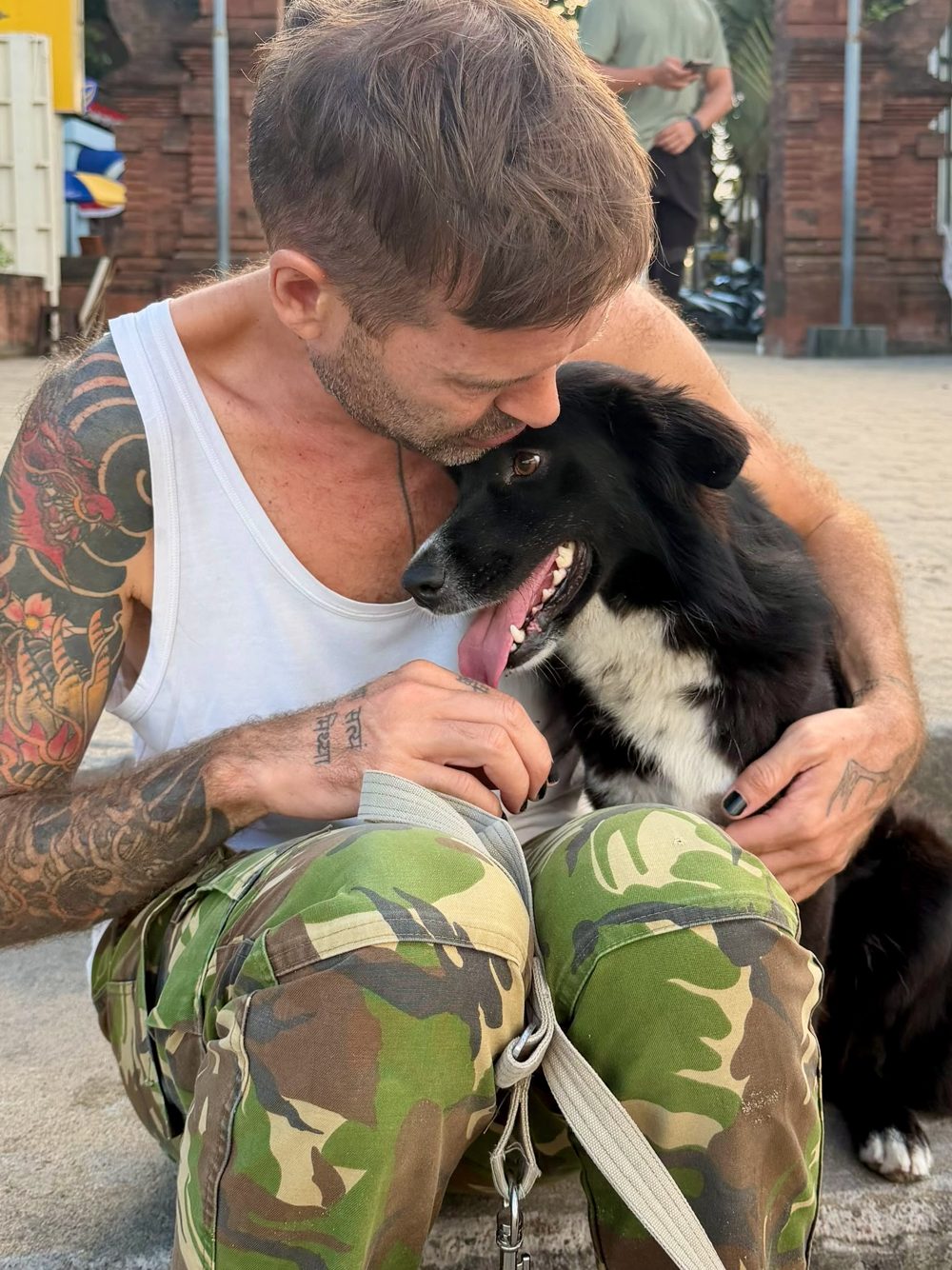
Ruby today. The same dog who wouldn't let me come within 20 meters... That's the relationship leadership creates.
Prey-driven "reactivity": she's cut off from her reaction the moment she's called back.
Every situation shown here is one AVSAB lists as "reactivity." Time to resolve them, according to that organization: "over time." Time it took me: a few dozen minutes of actual training.
Resource guarding — growling or biting over food, the sofa, or a person
What's called "resource guarding" is aggression: a dog threatening or biting to keep food, a space, or access to a person. The label isolates one context, but the cause runs deeper and wider — it's about the dog's overall status: food, territory, physical contact, sexuality.
That's why working on the food bowl alone is like patching a flat tire without removing the nail: the problem just moves elsewhere. The fix is establishing your leadership across all these areas at once, which resolves the aggression globally — whether it's directed at you, a third party, or another dog.
Separation anxiety — destruction, barking, soiling when you leave
A puppy is supposed to learn detachment early on — the same way he's weaned off his mother, he has to be gradually weaned off needing you in sight. When that step gets skipped, you end up with a dog who can't be alone: destruction, barking or howling, soiling, drooling, sometimes self-harm the moment you're out the door — or, in company, a dog who can't stand being out of your sight at all. It can also come from a dog who holds the leadership — since he's responsible for you, he has to watch you, so he needs to keep an eye on you at all times.
The fix is teaching detachment now, and taking the leadership. Both go together: a handful of consistent rules removes that anxiety and gets you a fully balanced dog who can stay peacefully alone.
Aggression — from nipping to deep bites, toward people or other dogs
Aggression isn't abnormal — it plays a full part in dogs' communication, and it has a purpose. Every dog is capable of it. It shows up to hold onto status, to control a territory, to catch prey, or out of fear. Toward people, it's mostly a family affair: family members are the most common target, because that's exactly where status gets contested.
Toward other dogs, a dog attacks to get the upper hand: to make a dog he meets submit on the spot, to keep other dogs out of a territory you occupy — a picnic, a spot on the beach, a chat with other owners — to claim a dog of the opposite sex, or to keep a ball, a stick, or food. The same four pillars of hierarchy every time: territory, contact, sexuality, food. And many dogs are aggressive only on the leash.
The fix is leadership combined with real obedience. At home with guests, at a café, a restaurant, or a friend's house, having your dog lie down as soon as you arrive keeps territorial defense from kicking in. On the leash, a proper heel stops aggression immediately. Off the leash, the recall cuts the interaction short before a fight — and sending your dog away the moment he tries to assert himself, then inviting him back warmly a few minutes later, teaches him that aggression costs him his place in the group. For a social animal, there's no stronger deterrent. It works because your dog already sees you as the leader — which is where my work starts.
The fearful dog — strangers, noise, objects, new places
Not the normal startle every dog has — a persistent, disruptive fear of ordinary things. It usually traces back to under-stimulation during the imprinting window, 3 weeks to 3 months old, when a puppy should be meeting noise, strangers, and new places regularly enough to build a frame of reference for "new isn't dangerous." But it can also come from a specific trauma.
The fix is two things together: taking the leadership, obtained through rules of life that lead your dog to rely on you and to imitate you — the ground for the real obedience you'll then use to ask your dog to hold a position near whatever scares him, moving a little closer each time, until he realizes that what scared him isn't actually harmful and gets comfortable with it, or at least isn't scared anymore. Progress isn't predictable in duration, but what's certain is that you'll be able to control your dog and free him of those fears — for some it's a matter of days, for others, weeks.
House soiling — accidents past puppyhood
Once the sphincter muscles are fully operational — a little before 5 months old — a dog is fully capable of holding it. If he doesn't, it's either to mark his territory because he's taken the leadership, or because his status and yours are ambiguous and it's a behavior aimed at asserting himself — or separation anxiety, if it only happens when he's alone.
The fix is the same leadership work — food, territory, contact, sexuality — to clarify the ambivalent status and take the leadership, plus, if needed, a structured one-to-two-week routine that teaches a dog where and when he's free to move, to prevent accidents while the new rules settle in and to increase your hold on the territory — which lowers his, so there's no reason for him to mark it anymore.
Barking — at noises, passers-by, or to get your attention
Some dogs naturally bark more than others — it's part of their personality. But some factors make it worse: hypervigilance to outside noises and movement (because the dog has taken on the role of defending the territory, or because he's fearful), separation anxiety, or barking to get something from you, like attention or a door opened.
Stopping it is quick. You could stop the barking for good, but I don't recommend it — barking is one of the ways a dog expresses himself. The better option: stop it on command.
Jumping on people — guests, children, or you at the door
Jumping on people isn't hard to stop — it's actually very quick. But it isn't solved with a quick tip: it resolves as part of the dog's overall education — the rules of life at home, leadership, and obedience.
Chewing — furniture, shoes, everyday objects
Chewing isn't hard to stop either, and it goes quickly. But here too, there's no isolated trick: it resolves within the overall education process. When it comes with separation anxiety, it's resolved together with it.
Getting help with your dog
I solve these problems in private lessons — and everything is also in my online course, step by step, without treats and without pain.