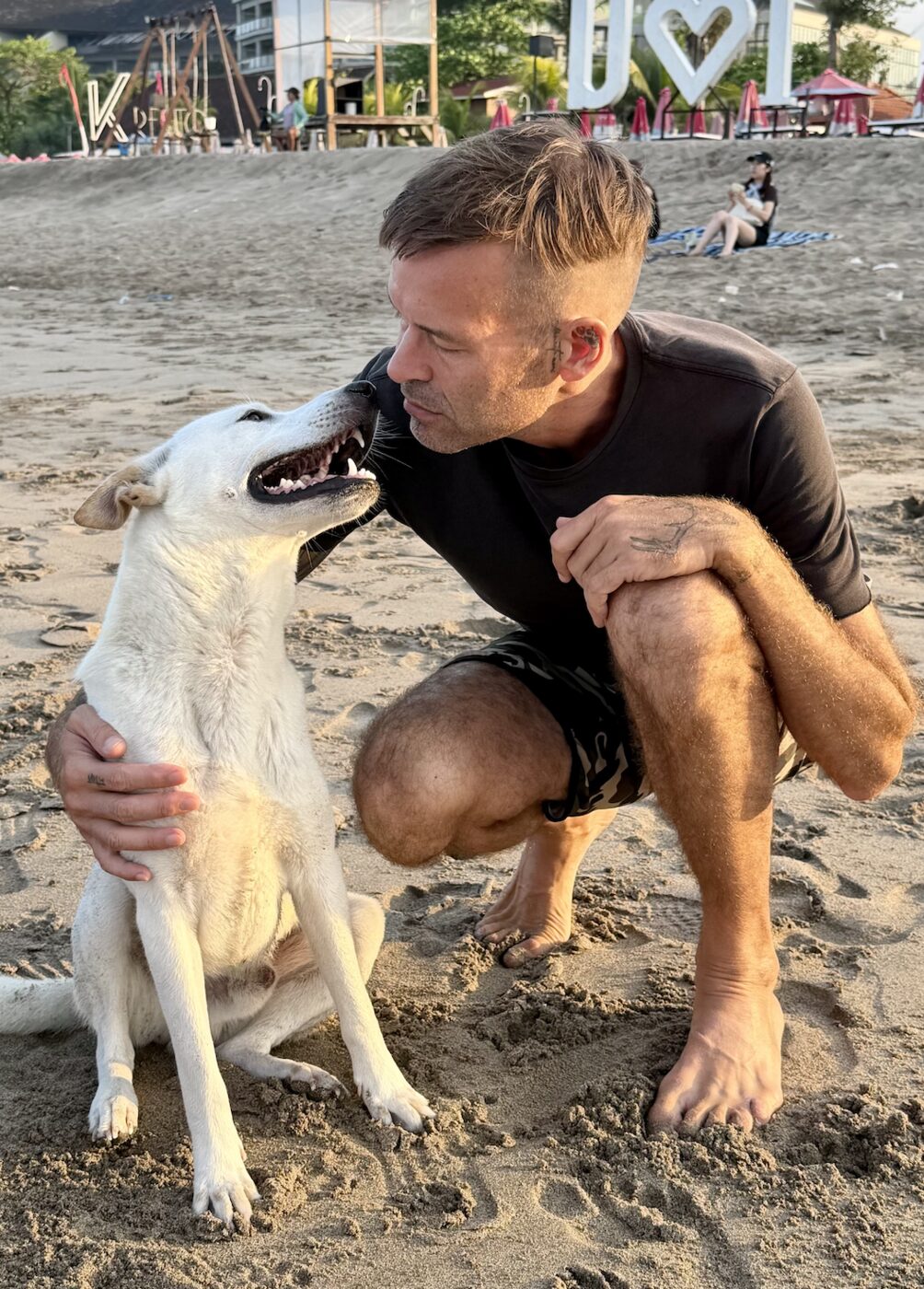
Unseen Footage on Hierarchy
You're being lied to about dog hierarchy. Does dominating a dog make him fearful and damage your relationship? That's what you're told. Ruby, Molly and Jody show the exact opposite, on camera. See for yourself →
What 30 years in the field taught me about hierarchy
During my studies in ethology and canine behavior, I read a great many books and academic theses. Some of them contradict each other and don't agree on how dogs behave or how their social organization works. Throughout all my years living with dog packs, I kept my eyes wide open — and what I observed, and still observe today, after 30 years, is backed up by the specialists quoted below — but also, and above all, proven by the footage of dog-to-dog behavior I filmed myself and am showing you here.
The notion of hierarchy contributes to a dog's well-being and balance. It is up to the owner to take responsibility for dominance, and only then will he make his animal happy. An animal that doesn't have to lead the pack will feel secure, since its needs will be taken care of. To be dominated does not mean to be humiliated — it means to be protected by the group, to feel safe. Dr. Patrick Pageat — Doctor of Veterinary Medicine; Advanced Studies Diploma in Entomology; Doctorate in Biological Sciences; Diploma from the European College of Veterinary Behavioral Medicine – Companion Animals; Accreditation to Supervise Research. Associate Professor of Applied Ethology and Animal Welfare at the Purpan Engineering School; Visiting Professor at the Veterinary Faculties of Pisa and Barcelona (Master's in Behavioral Medicine); creator of the clinical course "Behavioral Medicine and Consultation" at the Alfort Veterinary School. Three-time President of GECAF (Study Group on Pet Behavior); co-founder and Vice-President of ESVCE (European Society of Veterinary Clinical Ethology); member of the European Association of Veterinary Pharmacology and Toxicology; Honorary Member of CABTSG (Companion Animal Behaviour Therapy Study Group, UK); member of AFTCC (French Association of Cognitive and Behavioral Therapy); President of the European College of Animal Welfare and Behavioral Medicine.
Why don't we feel like dominating our dog?
There are areas of our lives where we accept hierarchy, and others where we don't. We accept hierarchy — along with rules and laws — in the way our countries, institutions, and companies are organized, even within religious and spiritual organizations. We accept it because we understand it's what holds a group together and keeps it going: society has laws, companies have rules, religions have commandments, and almost all of these collective organizations have leaders too — presidents, kings, CEOs, religious heads, and so on.
Read more
In our personal relationships, things are very different. Our relationships are driven by feelings, not by laws. Human groups rely on a regulatory framework as their foundation — a structure within which we still have freedom. In our relationships, though, feelings are the foundation.
What does this have to do with dogs? It comes down to the role we assign them, because that determines how we naturally treat them.
During the 19th century, the status of the dog changed completely. Until then, a dog was primarily a working tool. He had to perform a specific task; he had no choice in the matter — he simply had to do the job and comply. His living conditions prevented him from exercising any power or dominance: he lived outside the house, was fed on scraps, and feelings, when they existed, played only a marginal role in the relationship.
Later, the dog became primarily a companion animal — and moved inside the house, into the very space where a family's power dynamics play out. We no longer ask dogs to do a job; we keep them for companionship because we love them — feelings have become the foundation of our relationship with them.
And when it comes to feelings, concepts like power, hierarchy, and rules are completely irrelevant. We want to be pleased, and we want to please the other — that's how humans interact in personal, feeling-based relationships. In the same way, when we welcome a dog into our lives — driven by those feelings — we want to please him. But we do it in a human way, forgetting the dog belongs to a different species. His needs and expectations from the group are different. How he perceives what we give him — thinking we're pleasing him — is totally different too.
While we treat our dogs mostly based on feelings — which isn't a mistake in itself — we overlook the fact that he primarily needs structure. A dog doesn't live in a group for the sake of feelings, nor does he form attachments based on emotion, but rather for survival — much like we did originally. We began living in communities because, as hunters, we could take down larger prey in groups and were better able to withstand adversity. Dogs and humans share the same basic reason for group living: survival. And groups require structure, rules, and leaders.
Since we welcome a dog into our lives out of affection, we don't want to think in terms of hierarchy at all. Admirable as that instinct is, it isn't possible in reality. Why? Because a dog doesn't look for emotional bonding within a group — he looks for structure. That structure has to be consistent, meaning everyone's position is clearly defined, and those positions are hierarchical by nature.
We often hesitate to establish a hierarchy because we see dominance in relationships as unfair, harsh, or unjust; we don't want that kind of relationship with our dogs, mistakenly believing it's unkind to him. But that anthropomorphic view leads the dog — driven by instinct — to establish that hierarchy himself and take charge of it. He's compelled to lead the pack not by choice, but by nature: if a group has no leader, it's unlikely to survive, so he steps into the role we've unwittingly left open.
That position comes with heavy responsibilities though, and triggers various forms of anxiety in a dog who doesn't have the temperament to handle them. Even a dog with the right temperament finds daily life deeply confusing, because every time we ask something of him — leaving him home alone, choosing the direction of a walk, asking for obedience — his status gets challenged, and that happens constantly.
Dominating a dog has nothing to do with falling out of love with him or mistreating him — on the contrary, it means loving him for who he really is, and treating him according to his needs: it means respecting his nature. It means giving up loving an illusion of who we wish he were, for who he actually is. Dominating means taking charge so your dog doesn't have to shoulder that impossible task himself. And "dominance" doesn't carry the connotation you might think.
You should also know that if you dominate your dog, he'll become deeply attached to you, because you become his guide — the one he can lean on and count on. Your attention takes on real value, because it represents the care a leader gives. A dog is "loyal" to his family out of habit and an innate attachment to the group — something that can change quickly. But a dog is truly and deeply attached and loyal to his leader. By becoming your dog's leader, you won't just put him at ease — you'll build a bond with him deeper than you ever imagined possible, unlike anything you could have with another species.
"He is following me everywhere now... and very calm. Unlike before 🥹" Jasmine, course participant
Why "hierarchy" isn't what you fear
Same pattern, two different "opponents": a dog defending a position on the couch from another dog, and a dog defending that same kind of position from a human, on the bed. Hierarchy doesn't distinguish between species.
If that makes you uneasy — like working with it must mean being harsh with your dog — you're not alone, and I understand exactly why.
Read more
Before I studied dogs for a living, "hierarchy" was a bad word for me too. Dominating isn't in my nature — some people are drawn to that kind of power struggle with an animal; I've never been that kind of personality. I used to think the ideal relationship with a dog was being his friend, his equal.
What changed my mind wasn't years of practice — it was what my studies, and what I actually observed between dogs, taught me about a dog's real nature. Treating my dog as an equal had created real problems, for him and for me, and I couldn't go on that way. Making the change meant giving up a mistaken idea of who my dog was — and a harmful way of loving him — for the real thing. The good news: nothing about the affection had to go. I just learned the correct way to express it.
What you get from taking on leadership is the opposite of what you might fear. My dogs didn't become distant or fearful — they grew more attached than ever, and that's where a depth in the relationship is born that I'd never known before. I dote on my dogs; I love them more than some members of my own family. That's thirty years of hearing clients say some version of the same thing: "My dog has never been this calm, this balanced — thank you."
Hierarchy — on what basis?
When trainers argue online about dominance and hierarchy, it usually comes down to whose expert you believe — this author says one thing, that one says another.
Theories clash on this — some researchers argue hierarchy isn't real at all. I'm not asking you to take a side in that debate. I'm asking you to look at the footage I show you here, which illustrates the specific interactions that prove it. I spent thirty years studying, watching, and learning — on wild packs, semi-wild packs, street dogs, and packs living with humans. How many of the people arguing online can say the same?
Read more
Most trainers form their opinions from books alone. I started the same way — reading everything I could find on canine ethology and behavior, with no preconceived idea of what I'd find. But I didn't stop there: once I'd gathered everything available to me, I started living with a pack of 20 dogs, 10 of whom were constantly changing. These dogs weren't kept in kennels — they lived with me, at home. My own observations are what let me sort out, from everything I'd read, what actually held up and what didn't.
I've continued observing dog packs ever since — living alongside humans, near humans, or far from them. I've studied them in Costa Rica, Portugal, India, Mauritania, and several countries across North Africa, and for the past four years, daily in Bali and Sri Lanka too. What I've watched happen, over and over, is that every group of dogs settles into a structure with the same characteristics.
Everything I teach about hierarchy is grounded and proven on film. I don't ask you to take it on faith. I ask you to look at what actually happens in a group of dogs, which you see on the footage below.
It isn't a method based on theory — it's what happens when you stop arguing about dogs and start watching them, for three decades, without stopping. Nor is it a method that brings obedience only when there are no distractions around — it works anywhere, in any circumstances.
I tested nearly every method out there, until I applied the rules of life based on hierarchy as the source of obedience. It was a revelation in terms of efficiency — not only in the level of obedience itself, but because it also produces amazing balance in a dog, and is the only effective way to solve any behavioral problem. The results were incomparable to the small, partial changes other methods produced.
What follows is in two parts, and each builds on the other. First, observation: every pack I've studied — wild, half-wild, or living alongside us — led me to the same conclusions, like the packs I observe day after day, mostly in Bali, that I show you below. Then, filmed interactions: theories can clash on paper, but images cannot lie about reality — which is why, instead of just arguing the point, I decided to film it and show it to you. So I put dogs in situations that demonstrate, on camera, the exact behaviors I explain during the first in-home lesson I give. As far as I know, none of it has been filmed at this scale or this precisely anywhere else. That's not an opinion. It's the evidence.
Part 1 — Observation
The kinds of packs I've been observing in Bali — and, more recently, Sri Lanka — for the past four years. The same pattern shows up, further down, everywhere else I've worked.
A pack that has taken over the territory around a building, in Bali.
My latest observations in 2026, in Sri Lanka
A very strategic position
Interaction with humans
On the road…
A pack at the beach
Watch 4 more pack-observation clips
A larger pack at Seminyak beach, Bali.
A pack owns the territory this path is part of.
Another beach pack in motion, in Bali.
A loose beach pack in Bali — one of the dozens of pack configurations I track and film regularly.
The same pattern, photographed in other countries I've worked in:
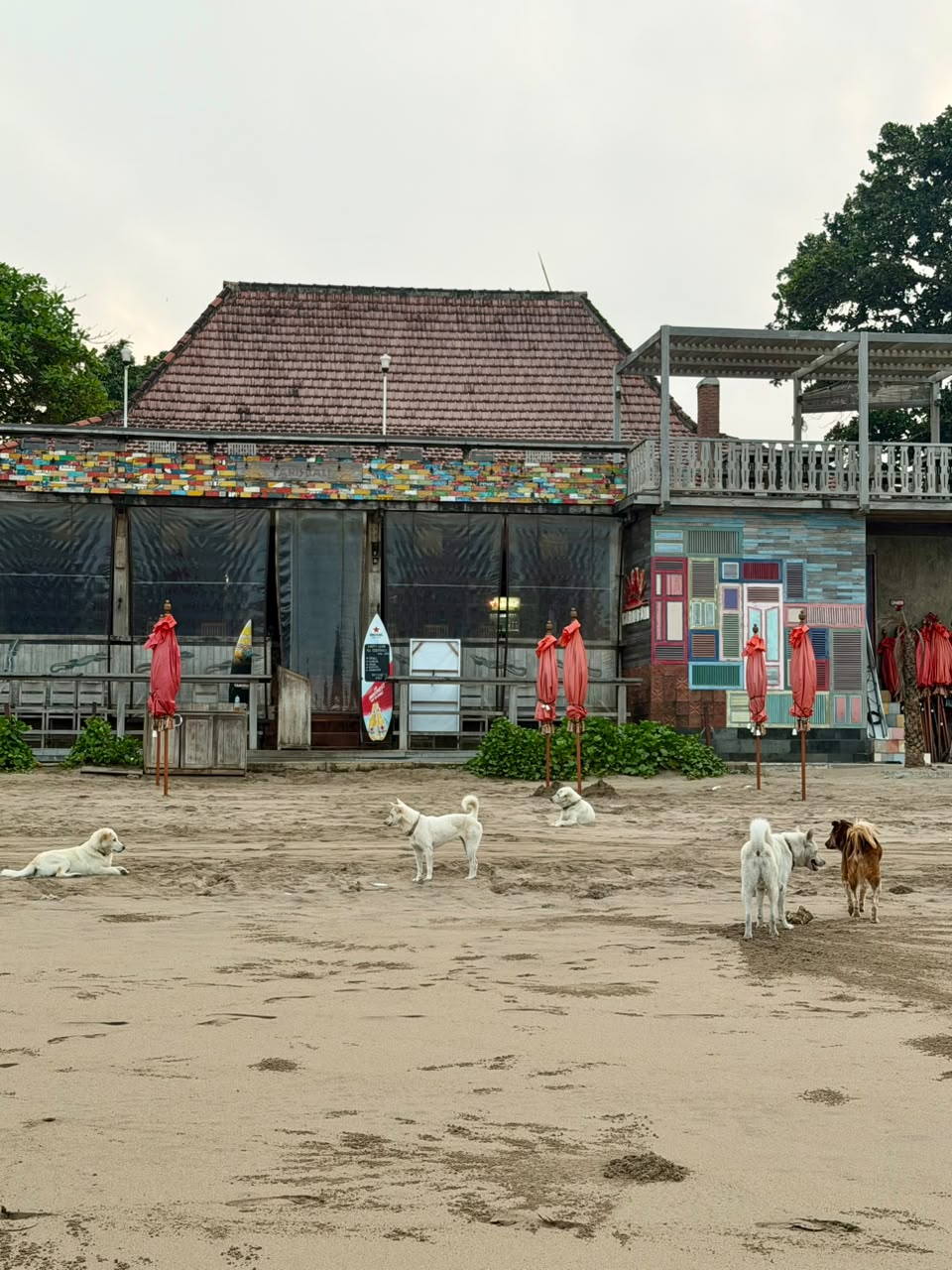
Bali, Indonesia
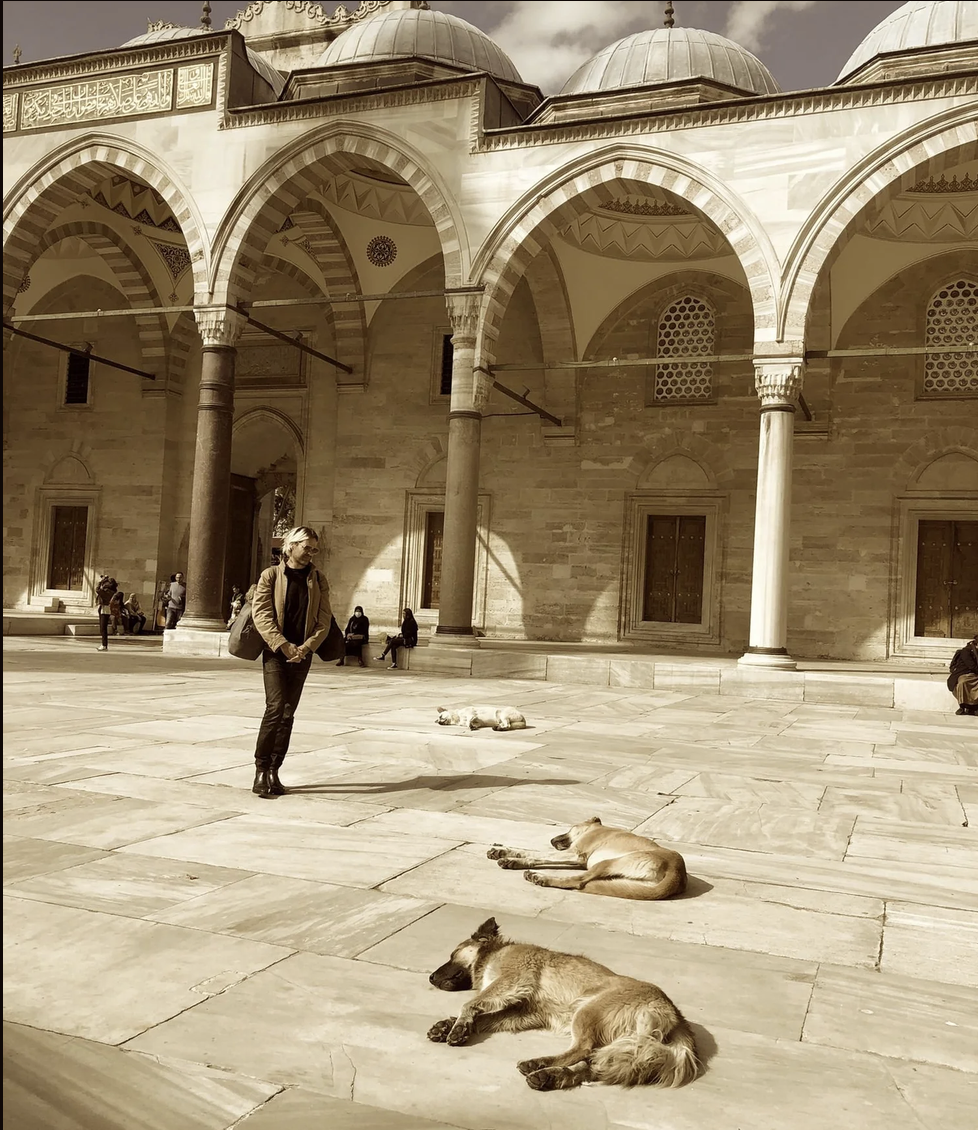
Turkey
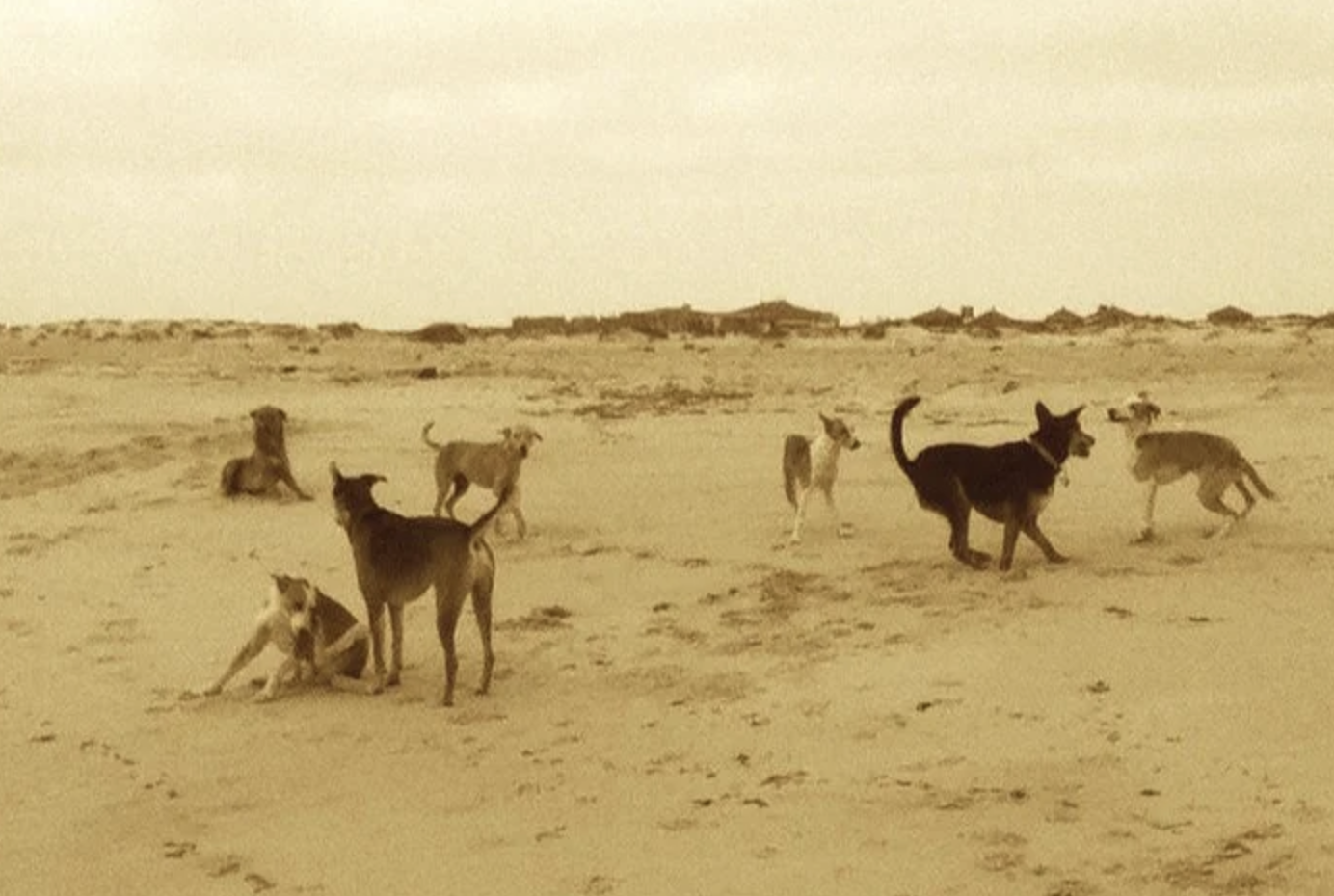
Mauritania
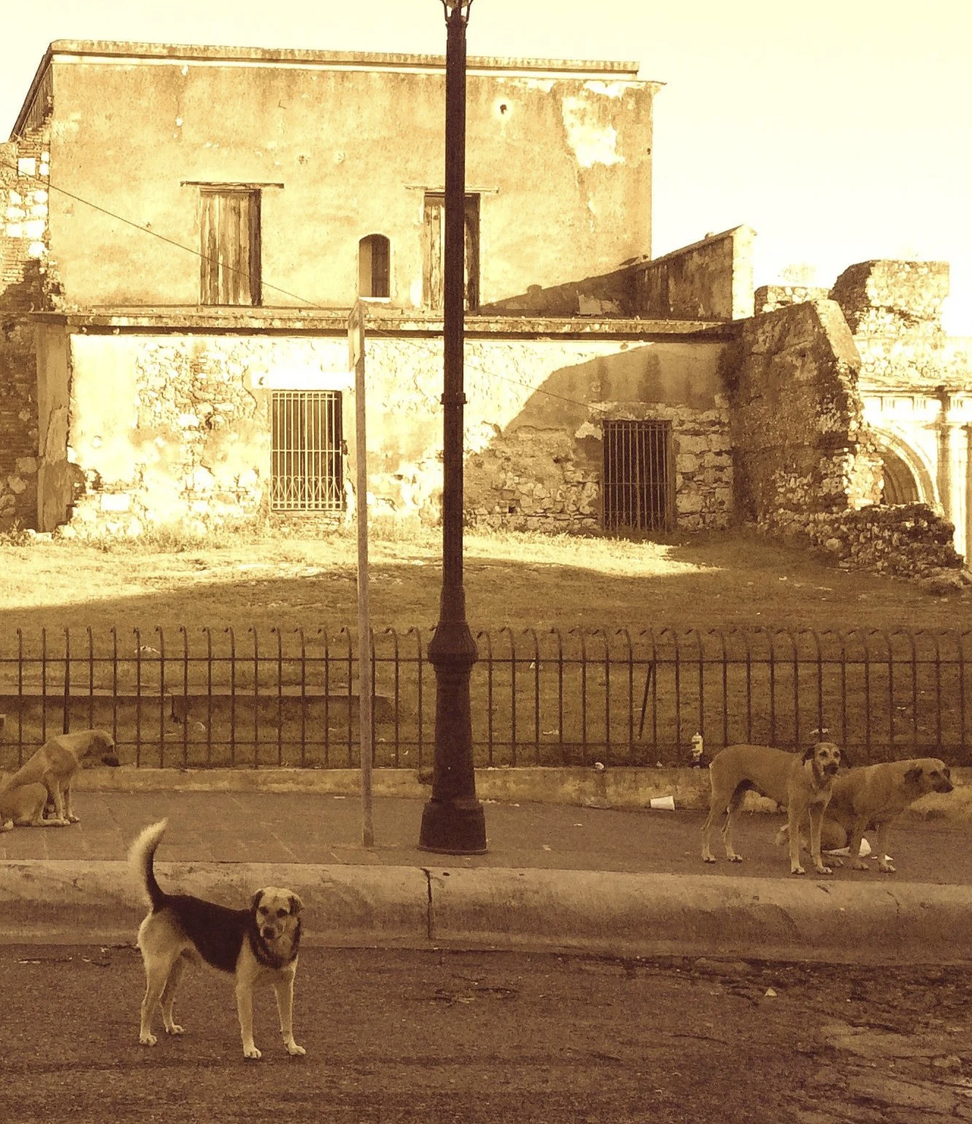
Dominican Republic
Part 2 — Never-before-seen footage of filmed interactions
From that same observation work, the interactions below are the ones I chose to isolate and film precisely — the clearest, most repeatable demonstrations of how hierarchy actually plays out between dogs.
What I teach rests on one foundation: leadership built on control of four things — food, territory, contact, and sexuality. Whichever dog holds that control is the one the others defer to. That's what the footage below sets out to show, one domain at a time — followed by one of its consequences: who leads the walk. Sexuality is part of that same framework, but it's the one exception here — I don't have footage of it to show.
Food
Two dogs, one bowl. Watch closely: the tan dog doesn't just eat from it — he picks the bowl up in his mouth and carries it off, taking control of the resource itself, not just the food in it. The black dog never tries to take it from him; he keeps his distance and waits his turn. That's what control of food looks like in practice — it isn't about who's hungrier, it's about who gets to decide what happens to the bowl.
Territory
Elevated position — a dominant will prevent a subordinate from accessing it while posted on it.
A dominant prevents a subordinate from entering until his inspection is finished.
A dominant may refuse a subordinate passage through a passageway.
Contact
A dominant decides when to initiate contact with a subordinate — not the other way around.
First: a subordinate got attacked after having initiated physical contact. Second: a subordinate that takes too much height gets pinned to the ground.
An adult teaches one puppy of her pack that physical contact cannot be initiated by a submissive.
Moves — a consequence of the four pillars
The leader decides the direction of the walk — a subordinate's movements don't influence the group's.
What the specialists say
The dog is a social being — to grow out of that, you have to establish this hierarchical relationship, in feeding, sleeping, and contact. It's the only way to structure and soothe the animal. Monique Bourdin, veterinary doctor, graduate of the Institut Pasteur in Paris, responsible for education and consultations in behavioral disorders at the French National Veterinary School
There are debates today among behaviorists — some say the hierarchy isn't real. They're wrong. You have to get into the hierarchy: if you don't do your job as pack leader, you're going to be in trouble. When you know the dog well, there's no question about it — it isn't for the dog to decide where he goes or what he eats. He shouldn't be the leader, because if you give him room and he's a bit of a wolf around the edges, he'll take the place of pack leader, and you'll have nothing more to say. You have to accept the hierarchy. Dr. Pierre Jouventin — expert ethologist, CNRS Research Director (1st Class), author of over 230 scientific articles in international peer-reviewed journals (A-rank). Head of the Behavioral Ecology team at CEFE and of the ETHOTAAF program (CNRS); Director of the Chizé Biological Studies Center (CNRS); Head of the CNRS Interdisciplinary Environment, Life and Society program; member of the Scientific Council and Ethics Committee of the French Polar Research Institute; Secretary General of the French Ecological Society; Vice-President of the European Federation of Ecology; Project Manager at the CNRS Life Sciences Directorate.
Dr. Pierre Jouventin wrote about my book: "You are right to go against the trend of purely positive reinforcement training, as well as the trend of denying hierarchy (one wonders how anyone can reach this conclusion when it only takes five minutes to observe it in dogs)… Dog trainers are heavily into positive reinforcement training for commercial reasons, since owners prefer not to say no to their beloved dog."
One consequence of denying hierarchy: every day in the United States, 1000 people are treated in hospital emergency departments for a dog bite, according to the National Electronic Injury Surveillance System (NEISS-AIP). And more than 80% of these bites happen... at home — inflicted on family members and those closest to them.
Treat your dog like a human, and sooner or later it will remind you of its true nature.
Why do these accidents happen? For Monique Bourdin, veterinary doctor at INSERM and specialized in canine behavioral disorders, the answer is clear: "Accidents by bites are essentially linked to the failure to respect the species' way of life." She adds: "The dog is a social being; to thrive, it must live this hierarchical relationship."
Hierarchy and affection
Establishing a hierarchical relationship means respecting your dog's nature — respecting your dog. He's an animal who has kept all his instincts and his social way of functioning. Denying that harms him, and it's what generates most of what people call "behavioral troubles."
But establishing a hierarchical relationship is not at odds with the love and affection you feel for him — quite the opposite. The living environment you put in place structures him and puts him at ease, and within that framework you can still pet him, play with him, and give him all the affection you want — as often and for as long as you like. That framework is what a real closeness with your dog grows out of.
And the more your dog perceives you as a leader, the more attached to you he'll be — he's wired to follow a strong leader, because that leader gives him a better chance of survival.
Isn't respecting his true nature proof of love?